Picking the first freelance marketplace is kind of like choosing where to sit in the cafeteria of a high school. You wouldn’t want to get stuck with the “cool kids” only to discover that you don’t have lunch money to spend with them, but at the same time, it would be pretty embarrassing to get stuck in the corner where no one would notice you sitting there anyway. If you find yourself standing in front of the screens of Upwork and Fiverr as we begin the year of 2026 trying to decide where to make your stand there with others, then believe it or not, you’re not the only one. Both of them rule the market but treat the freelance community completely differently.
Let’s take apart “The Big Two” so that you can finally put down that phone and start making some grocery money.
The Storefront vs. The Battlefield
First thing, you need to understand the “vibe” of each site. Fiverr is really a digital shopping mall. You are the shop owner. You create a “Gig” let’s use, “I will create a logo for $50,” for example and then you sit back with your cup of coffee as someone walks into the shop to purchase your product. If you hate writing cover letters and just want to do the work, that can be great.
Upwork, however, is more of a 24/7 job fair. You, the freelancer: Clients post a project and you (and 50 other people) have to pitch for it. You write a proposal, prove you’re the best and, in some cases, get on a fast Zoom call. It’s more action-packed, a little bit aggressive and certainly takes a greater toll on social energy. If Fiverr is a shop, Upwork is a battlefield, but the rewards are often higher.
The Pain of the First Five Dollars
Now let’s get to the part that stings: the fees. Both are like that friend who never brings a sandwich but always wants a bite. On Fiverr, the math is simple enough but brutal. They take 20% of everything. Sell a gig for $100, and you’ll keep $80. It doesn’t matter if it’s your first order or your hundredth with that client. It’s a flat tax on your labor.
Upwork used to have a confusing sliding scale, but they now feature just 10% fee in fine print. However, there’s a catch. Even to bid on work posted on Upwork, you need “Connects.” These are digital tokens that must be purchased with real money. So you’re paying for the privilege to ask for work. It’s a little bit like buying a lottery ticket, in which the prize is … more work.

Hunting for Clients vs. Being Hunted
Landing your first client feels like unlocking a boss level. You are powerless to the Algorithm on Fiverr. If you use the wrong keywords in your headline or if your thumbnail looks like you created it in MS Paint (1995 edition), then you’ll be buried on page 402. But once you start to build up some of those early 5-star reviews, the momentum can really take off. It’s like a snowball rolling down a hill — after you get it started, there’s not much more to do.
Upwork flips the script. You’re not waiting, you’re hunting. You choose your targets, write proposals, and try to land work. You can move fast. Really fast. One good pitch, and you’ve got a contract today. But it comes at a cost. You might send twenty proposals and hear nothing but silence. It’s a grind. The upside? You’re in control. The downside? It’s all on you.
Which Skill Fits Which Hand?
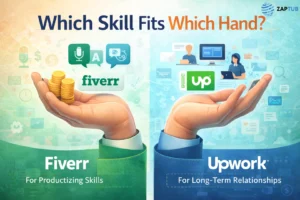
If what you’re selling is a very specific “product,” such as a voiceover, translation, or logo, Fiverr bit is your best friend. You Get to Productize Your Talent. You do the same thing again and again, becoming quicker and more adept each time. It’s about volume.
Where the big fish swim If you consider yourself more of a “consultant” or on longer-term partner (think virtual assistant, dedicated developer for your website, or writing long-form content), head over to Upwork. It’s good for forming the kind of relationships that last months rather than days. You are more than a “gig” worker you are an extension of their team.
Dealing with the “Scammy” Side of Things
The internet is full of weirdos, let’s be honest. Both are also overrun with scammers looking for free work. On Fiverr, you will get the odd “Buyer” who asks for 10 revisions and then attempts to cancel the order at that point. You’ll find jobs that are far too good to be true on Upwork, and then they’ll ask you to speak with them via Telegram.
The good news is that both of these sites have solid escrow systems. On Upwork, the cash is “locked” in advance before you begin, which is a piece of mind. On Fiverr, the customer pays before buying. As long as you’re doing all your talking and working in the platform, you are generally O.K. If you’re approached, or even asked if you want to be paid in “exposure” or some cryptocurrency through a third-party app, run faster than a freelancer spotting 1-star review.
The Learning Curve for Beginners
Fiverr is easier to get kicked off but more difficult to master. You can create a gig in 10 minutes, but getting it to appear in search results requires some SEO magic and possibly a dash of luck. It’s a game of patience. You could go three weeks between your first “ding” on the Fiverr app.
Upwork may be more of a learning curve. You need to learn how to write a proposal that doesn’t sound as if it was written by a robot. The majority of newbies are throwing out the pitch: “I can do this job, hire me please.” Upwork’s pros concentrate on the client’s problem. If you figure out the pitch, Upwork is a goldmine. If you hate writing and selling yourself, you’re going to have a bad time.

Global Competition and Pricing
One thing that can surprise new freelancers is how global these sites are. You are competing against people from everywhere in the world with a possibly much lower cost of living. That’s when we enter “The Race to The Bottom,” where people are paying $5 for logo designs.
Don’t fall for this trap. If you are on Fiverr or Upwork, don’t be the cheapest. Those who are least expensive to serve often complain the most. Position yourself as the “Not Cheap” choice. Even as you’re getting started, charging a fair price demonstrates that you think your time is valuable. If you don’t value your time, why should a client in New York or London?
Conclusion
In fact, the vast majority of successful freelancers never even make the choice. They treat it as a buffet, grabbing two plates and taking a little from each. You can keep a few gigs live on Fiverr for “passive” inquiries even as you’re actively stalking high-paying whales in Upwork.
The most important thing? Don’t get discouraged. Your first month would probably contain a few days of staring at an empty inbox and wondering whether you’d made the right decisions in life. That’s normal. Just know that every “Top-Rated” freelancer had zero reviews and a profile picture they most likely regret now. So, choose a platform, semi-professionalize your profile and get going already. The internet is a big place, and there’s room to get your slice of the pie even if the platforms take a big bite first.
