If you’ve ever attempted to make something grow on the internet, you’ve likely come across this debate: organic marketing or paid marketing? One side argues that organic is slow but “pure.” The other doesn’t that paid is “fast” but also “expensive.” Meanwhile beginners are caught in the middle not knowing whether to blog for six months or simply throw money at ads and pray.
The reality is less sensational and a lot more pragmatic. Paid and organic marketing aren’t enemies. They are tools. And, like any tools, they tend to work best when you know what they actually do.
Let’s clear the confusion.
What is organic marketing?
Organic marketing is reaching at people’s heartstrings without paying for ads. It concentrates on building content and experiences that people naturally find either through search engines, social media or word of mouth.
This typically involves the production of blog posts, search engine optimization (SEO), organic social media and email newsletters, community building that sort of thing. You don’t pay a platform to present your content. Instead, you gain attention by being helpful, interesting or entertaining.
Trust is the biggest benefit of organic marketing. It doesn’t feel like being sold to people. The downside? It takes time. Sometimes a lot of time. Organic marketing is just like going to the gym. And nobody gets results in a week, no matter how motivational the playlist.
What is paid marketing?
Paid marketing is so much easier. You pay money to get your message in front of people.
That includes ads you pay for on search engines, social media ads, sponsored content in marketing blogs and even paid radio spots. You donate money, and in exchange you receive visibility.
The primary advantage of paid marketing is speed. You can turn on a campaign today and get traffic today. The trouble is, as soon as you stop paying, the traffic tends to stop too. Think of paid marketing as renting a house. It’s helpful but it doesn’t belong to you.
Organic vs. paid marketing: Which is better?
This is where most people are asking the wrong question.
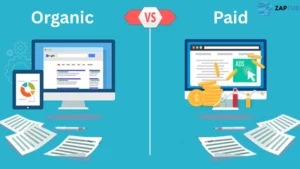
Neither organic nor paid marketing is “better” by itself. They have different functions at each stage. Organic marketing provides long-term visibility and trust. Paid marketing provides instantaneous reach and control.
If organic growth is your only objective, growth may feel painfully slow. You can have to pay money if you depend solely on paid, so costs can spike quickly. The smart approach is knowing when to use each one, not choosing sides as if it were a football game.
How Ahrefs uses organic and paid marketing.
Ahrefs is a great example of the combination of two approaches.
Their organic marketing is very strong since they put up detailed blog content that gets indexed in search and educates readers. Once it’s published, that content continues to drive visitors for weeks and months.
At the same time, they’ll use paid marketing to amplify content and extend its reach to new audiences on channels where organic reach could be low. The paid ads enable them to amplify what already works, rather than replace it.
And the lesson here is clear: paid marketing accelerates organic. It doesn’t replace them.
How to create an organic marketing strategy
Organic marketing is most effective when there’s a strategy in place. Posting at random and hoping for the best is not a plan.
Step 1. Choose an audience
This sounds simple but is where many go off the rails.
If you don’t know exactly who you’re going after, you’ll be targeting the wrong people. So a business that writes technical articles might attract industry professionals rather than actual buyers, for example. Traffic rises, but sales stay steady, and then people get confused.
There is only one case in which the organic marketing works, if the audience meets your business goal.
Step 2. Choose a goal
Not everything is meant to be sold right now.
Some content builds awareness. Some builds trust. Some helps retain existing customers. And when you understand that end goal? You stop wanting every single blog post to turn into money.
Expectations matter. Especially realistic ones.
Step 3. Choose a platform
Organic marketing isn’t just “write blogs and hope for the best” though.
It could be blogging, YouTube, social media platforms such as Instagram or X scratching LinkedIn on TikTok email newsletters podcasts or online communities. The error is attempting to do them all at once.
Begin by establishing one or two platforms where your audience is already spending time. You can generally not go wrong with blogging and video if you’re unsure since that’s where people pull information.
Step 4. Choose a format
And even once you pick a medium, you have to figure out how to present yourself.
On social media, it may be pictures, quick videos, text posts or stories. On blogs, that could be guides, comparisons or tutorials. The format has to fit how your audience wants to consume content, not what is the easiest thing for you to produce when you’re feeling lazy on a certain day.
Final thoughts
Organic and paid aren’t like wet and dry. They are partners.
Organic marketing is like planting a seed and watching it grow. Paid marketing sprinkles in speed and scale as necessary. Businesses who win in the long-run know this and do both, purposefully instead of emotionally.
If you’re new to all of this, stick with organic. Learn how your audience behaves. When you’re ready to grow more quickly, use paid marketing to provide a boost behind what’s already working.
And keep in mind that there is no strategy if you stop too soon. Especially organic. Part of the plan involves patience, even if it’s something no one wants to hear.
